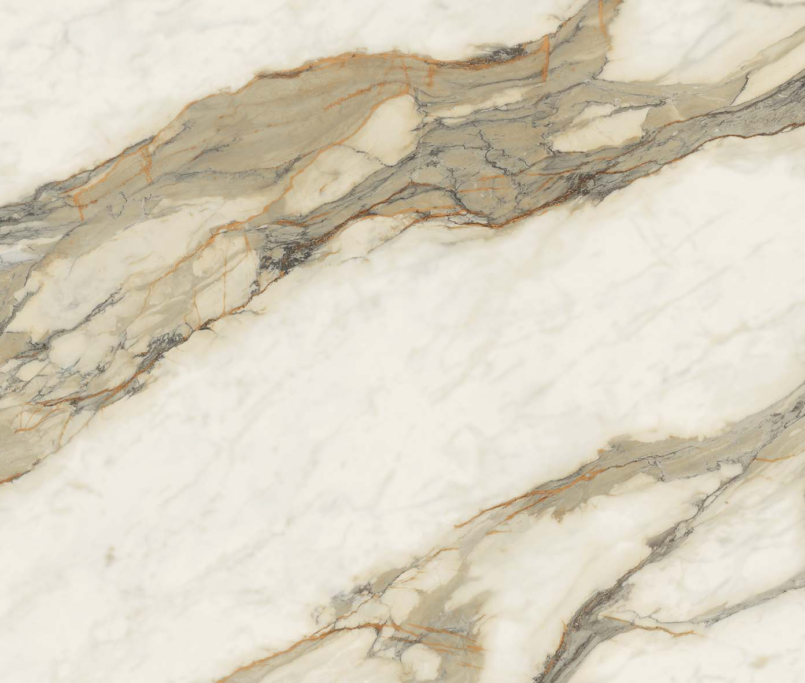
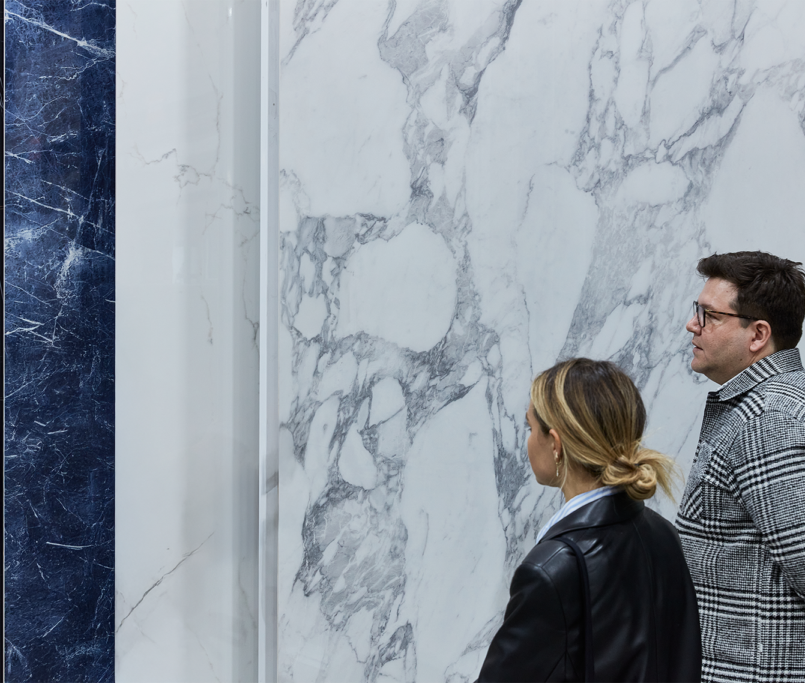
6mm Porcelain Slabs: Wall and Furniture Cladding
6mm is the thickness most people underestimate. It is not a budget version of a 12mm slab. It is a different material for a different job, and the reason it gets specified is almost always weight.
Clay International are the UK distributor for Infinity Surfaces. 52 of the slabs we stock are available in 6mm, and seven of them are made in 6mm only. This page covers what the thickness is for, where it is the wrong choice, and what it asks of whoever is fixing it.
What 6mm porcelain is for
6mm is a cladding material. It goes on vertical surfaces and onto things, rather than spanning between supports.
- Wall cladding. Full height bathroom and shower walls, hallways, stairwells, lift lobbies and reception walls. One panel can cover a wall floor to ceiling with no horizontal join
- Furniture and joinery cladding. Island faces, bar fronts, reception desks, wardrobe and door fronts, bath panels
- Over existing surfaces. 6mm can often go over sound existing tiling, which avoids the mess and cost of stripping back. This is a large part of why it is used in refurbishment
- Ceilings and soffits, where weight is not negotiable
- Lift car interiors and column casings, where every kilo counts and the surface has to survive heavy public use
Weight and handling, which is the real reason
A 6mm slab weighs roughly half what the same slab does in 12mm. On a single panel that is a convenience. Across a project it changes what is possible.
It decides whether a wall needs strengthening before cladding. It decides whether a panel can be carried up a stairwell by two people instead of lifted in. It decides whether a lift car can be clad without exceeding its load allowance, and whether a partition can take a full height finish without being rebuilt.
On refurbishment work this is usually the whole argument. The building is already there, the substrate is whatever it is, and the lighter the finish the fewer the consequences.
Infinity slabs have a working area of up to 3200 x 1600mm in 6mm, so a single panel covers most full height walls without a join. Fewer joins is the other half of the appeal: a clad wall with no horizontal break reads as a surface rather than as tiling.
Where 6mm is the wrong choice
This matters more than the list of applications, because specifying 6mm in the wrong place is an expensive mistake.
- Worktops. Use 12mm, or 20mm where the edge is on show. A worktop has unsupported spans, cut outs for sinks and hobs, and point loads. 6mm is not the material for it
- Floors taking point loads. Heavy castors, trolleys, pallet traffic and plant will find any void under a thin tile. Floors generally want 12mm or thicker, bedded properly
- Unsupported spans of any kind. 6mm needs continuous support behind it. It is a facing, not a structural panel
- Exposed edges without a return. A 6mm edge looks like what it is. Where the edge will be seen, either mitre it or move up a thickness. Our guide to the mitred edge detail covers how that is done
Fixing and substrate
Large thin panels are unforgiving about what is behind them. The common failures are all substrate failures rather than material failures.
- Flatness is everything. A large panel cannot follow a wavy wall, and forcing it to introduces stress. Substrates usually need levelling before cladding begins
- Full adhesive coverage. Voids behind a thin panel are where cracks start, particularly under impact or where something is later fixed through the surface. Back buttering as well as trowelling the substrate is normal practice on large format
- Flexible, large format rated adhesive. Follow the adhesive manufacturer specification for the substrate and panel size rather than a general purpose tile adhesive
- Movement joints where the manufacturer and the substrate require them, especially on long runs and where materials change
- Handling on site. Large thin panels are carried on edge, never flat, and frames or suction lifters are standard on full size sheets
Mechanical and ventilated facade systems exist for external cladding and are a separate specification. Talk to us early if that is the application, because it affects which slabs and finishes are suitable.
What is available in 6mm
Most of the Infinity range. The marble effects, the stone and travertine effects, the concretes, the plasters and sandstones of the Arkeon range, the onyx effects and the solid colours are all stocked in 6mm.
Seven are made in 6mm only, which tells you what they are designed for: the Holos mosaic panels, Arkeon Fossil Row GB03 and Fossil Tartan GB02, and Metal Corten Red ME03. These are decorative wall surfaces, not worktop materials.
The large format porcelain slabs guide covers the range more broadly, and every slab we stock has its own page with the thicknesses and finishes it is held in.
Common questions
Can 6mm porcelain be used on a floor?
In light domestic use over a properly prepared, fully bedded substrate it is used on floors, but 12mm or thicker is the safer specification and the one we would normally recommend. Anywhere with trolleys, castors or heavy traffic should not be in 6mm.
Can 6mm go over existing tiles?
Often yes, provided the existing tiling is sound, well bonded and flat, and the build up in thickness is acceptable at doors and reveals. It is one of the main reasons 6mm is chosen for refurbishment.
How much lighter is 6mm than 12mm?
Roughly half the weight for the same panel area. That is what makes it viable for walls, ceilings, lift cars and lightweight partitions.
Can 6mm be used for a kitchen island?
For the vertical faces of the island, yes, and it is commonly specified that way. For the worktop itself, no. Use 12mm or 20mm for the top and 6mm to clad the sides.
Does Clay International install?
No. We are the UK distributor for Infinity Surfaces and supply the slabs to the trade. Installation is done by tilers and fabricators, and our stockist and fabricator finder lists specialists by location.
Seeing the material
Full slabs are held at our London and Manchester warehouses and can be viewed by appointment. On a wall panel the finish and the scale matter more than they do on a sample, so it is worth the trip. We supply the trade across the UK, so your tiler, fabricator or studio can order on your behalf. Find your nearest through the stockist and fabricator finder, or get in touch to talk a specification through.