Porcelain vs Quartz Worktops
Ask ten worktop suppliers and fabricators which material is “best” and you’ll get ten pitches. As a distributor founded by a fabricator, we’d rather give you the trade view: both porcelain and quartz are excellent surfaces, and each wins in different situations. Here’s how they actually compare on the bench and in the home.
The two materials at a glance
Quartz is an engineered stone: roughly 90% crushed mineral bound with polymer resins, cast into slabs. Porcelain is a fired ceramic: refined clays and minerals pressed and kilned above 1,200°C with no resin content. That single difference — resin versus no resin — explains most of the practical differences below.
Heat
Porcelain is heat-resistant to very high temperatures: a pan straight from the hob won’t scorch it. Quartz’s resins can discolour or crack under the same treatment, which is why every quartz warranty tells the homeowner to use a trivet. If your customer cooks seriously, this is porcelain’s clearest win.
Sunlight
Porcelain is UV-stable, so it doesn’t yellow or fade — which is why it can be used for outdoor kitchens and facades. Quartz is generally an indoor-only material; resins yellow with prolonged UV exposure, especially in lighter colours and south-facing rooms with big glazing.
Scratching and staining
Both materials resist everyday scratching and staining well. Porcelain’s fired surface is harder and virtually non-porous without the requirement for sealing; the usual caveat is that heavy impact on an unsupported edge can chip either material — porcelain’s chips are less forgiving to disguise.
Fabrication — where quartz answers back
- Quartz is an easier product to put through a fabrication workshop. It’s less brittle and more plastic-like in its makeup. Fabricating porcelain requires more care and attention.
- Porcelain fabrication requires a slower cutting speed, the correct cutting blade and experienced masons throughout the process.
Weight and thickness
6mm and 12mm porcelain slabs are much lighter than 20mm and 30mm thick quartz builds, opening up furniture, wall cladding and door faces that quartz can’t sensibly do. For a solid-feel worktop, 20mm porcelain — the preferred thickness for UK stone fabricators — competes head-on.
Cost
Slab-for-slab on premium quality quartz and porcelain the materials overlap on price; the real difference in the final cost will be in the fabrication labour — as mentioned above, porcelain requires a more experienced fabricator mason. Porcelain’s current fabrication premium narrows as your workshop team gains experience with it.
So which should you offer?
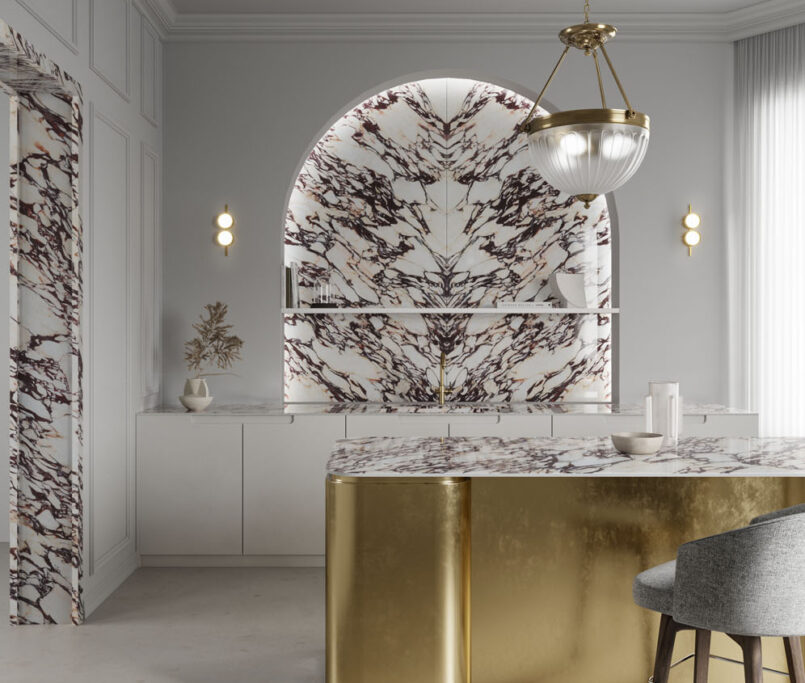
Both — which is exactly what most successful studios now do. Specify quartz where budget-led indoor kitchens want a proven, easy-to-fabricate surface. Specify porcelain where the brief includes serious cooking, outdoor areas, bookmatched feature pieces, large formats with minimal joins, or full-height cladding. If a project could go either way, the deciding questions are: will it see direct sun, direct heat, or the outdoors?
The fastest way to settle the debate is with full slabs, not samples. Visit our London or Manchester warehouse — all visits by appointment — and we’ll talk through your project honestly, including when we’d tell you quartz may be the right choice. Start with our complete guide to porcelain slabs in the UK, or call +44 (0)20 8971 7948.