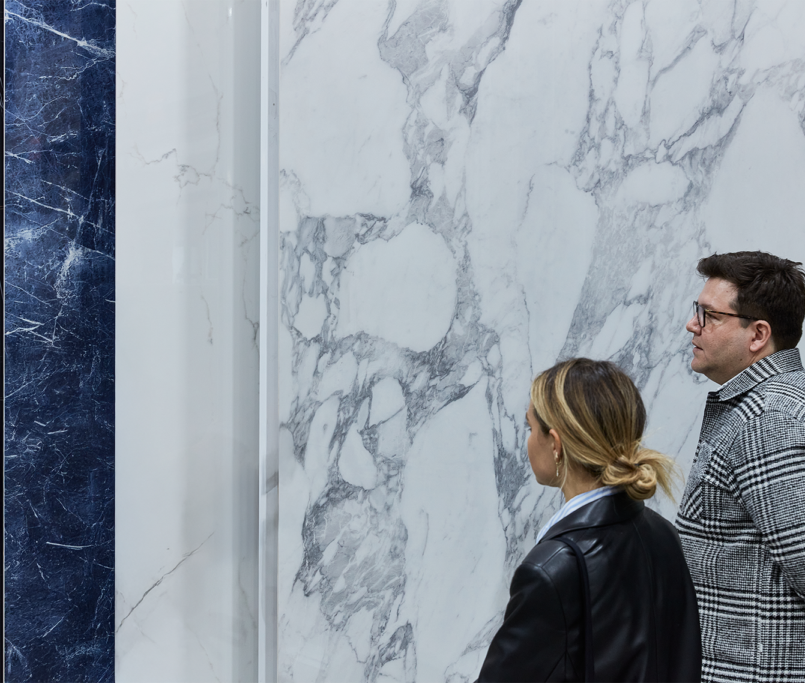
Porcelain Tables: Custom Dining and Coffee Tables
Porcelain tables have moved from a specialist choice to a standard one. A single large format slab can span a dining table without a joint, carry a marble, stone or concrete look, and take daily use in a way natural stone cannot. This page covers what porcelain tables are made from, what can be customised, and how to have one made in the UK.
Clay International distributes Infinity Surfaces porcelain slabs across the UK. We do not make tables ourselves. We supply the material, and fabricators and furniture makers turn it into finished pieces. If you are looking to have a table made, the section on commissioning one at the end of this page explains how that works.
Why porcelain works for a table top
A table top takes more abuse than almost any other surface in a home. Hot pans, red wine, keys, laptops, sunlight. Porcelain handles all of it because the properties are in the material rather than in a coating.
- Scratch resistant. Cutlery, ceramics and keys do not mark the surface in normal use.
- Heat resistant. A hot pan or dish can go straight down without a trivet.
- Stain resistant. The surface is non-porous, so red wine, coffee, oil and ink sit on top rather than soaking in.
- UV stable. Colour holds in a conservatory, a south-facing room or outdoors.
- No sealing. Unlike marble, there is no annual treatment. Soap and water is the maintenance.
That last point is the one that usually decides it. A marble dining table is beautiful and needs looking after. A porcelain one that looks like marble does not.
Custom porcelain dining tables: what can actually be changed
Almost everything. Because the table is cut from a full slab rather than bought as a finished product, the dimensions are set by the project rather than by a catalogue.
Size and shape
Infinity slabs are supplied at 3240 x 1620mm, which is large enough for most dining tables to be cut from a single piece with no join. That matters visually, because a joint across a table top is difficult to disguise.
Shapes are cut to drawing. Rectangles and squares are the common ones, but ovals, rounded rectangles, racetrack shapes and asymmetric tops are all achievable. Awkward rooms are often the reason people commission rather than buy.
Thickness
Tables are usually made in 12mm or 20mm.
- 12mm gives a lighter, more contemporary look and is easier to handle on larger spans.
- 20mm reads as more substantial and is the usual choice where the edge is on show.
Thickness is a visual decision as much as a structural one, because the edge detail can change the apparent depth entirely.
Edge profiles
The edge is where a bespoke table is won or lost.
- Mitred. Two pieces joined at 45 degrees so the top appears far thicker than the slab, with the veining running over the edge. This is the detail behind most of the thick, monolithic tables you see in design magazines.
- Chamfered. A cut angle that lightens the edge visually.
- Bullnose. A rounded edge, softer and more forgiving in family settings.
- Square. The slab thickness left as it is, clean and simple.
Mitred edges are the most requested and the most demanding to fabricate. We have covered the detail separately in our guide to mitred edges in porcelain.
Finish
Finishes run from soft-touch matte through to high gloss polished. Matte hides fingerprints and suits a quieter interior. Polished lifts the veining and reflects light, which suits a statement piece. The same slab in two finishes reads as two different materials.
Base
The top is only half the table. Bases range from minimal steel frames and single pedestals through to legs clad in the same slab, which gives a table that appears cut from one block. Your fabricator will advise on support, because span and thickness decide what the top needs underneath it.
Choosing a slab
The look comes from the slab, so this is the enjoyable part. The ranges divide broadly into marble effects, stone effects, concrete effects and plains.
Marble effects are the most popular for dining tables. Veined options such as Calacatta Viola give a strong, directional vein that suits a large top, while calmer whites suit a room that already has a lot happening in it. Concrete and plain finishes tend to be chosen for desks, boardroom tables and commercial settings.
One thing worth knowing before you choose: veining is directional. On a large top the vein can be positioned, and on a mitred edge it can be run over the corner so it continues down the side. Slabs can also be bookmatched, so two halves mirror each other across the centre. These decisions are made at the slab, which is why seeing the actual material matters. If you already know you want the violet vein, the guide to Calacatta Viola porcelain covers how it behaves on a large top.
Porcelain tables in commercial spaces
Restaurants, cafes, hotels and offices put a table through in a month what a home does in a year. Porcelain is specified in those settings for practical reasons rather than aesthetic ones.
- Spills do not stain, which matters where tables are turned over several times a day
- Surfaces clean with standard products, with no sealing schedule to maintain
- Scratching from cutlery and crockery does not show in the way it does on softer surfaces
- Colour and finish can be matched across a large number of tables from the same batch
For hospitality projects, batching matters. If a scheme needs twenty matching tops, those slabs should be reserved together. Talk to us early if that applies, because ranges move.
Outdoor tables
Porcelain is UV stable and unaffected by frost and rain, so it suits garden and terrace tables as well as indoor ones. The usual specification outdoors is 20mm. Bases need to be chosen for outdoor use, and the table should be supported properly, but the top itself needs no seasonal treatment.
How to have a porcelain table made
The route is straightforward.
- Choose the slab. You are welcome to view full slabs at our London or Manchester warehouse by appointment. Samples are useful but a 50mm sample tells you very little about a veined slab.
- Appoint a fabricator. They will cut, edge and finish the top, and advise on the base and support. We supply the material to fabricators across the UK, and our stockist and fabricator finder lists specialists by location.
- Confirm the detail. Size, shape, thickness, edge profile, finish and vein position are all agreed before cutting, because a slab is cut once.
If you are a designer or fabricator specifying for a project, or a homeowner trying to work out whether what you have in mind is possible, get in touch and we will point you in the right direction.
Common questions
Can a porcelain dining table be made in any size?
Within the slab size, yes. Infinity slabs are 3240 x 1620mm in 12mm, giving a usable working area of 3200 x 1600mm, so most dining tables are cut from a single piece. Larger tables are possible but will involve a joint, which should be discussed with your fabricator first.
Is porcelain better than marble for a table?
For durability, yes. Porcelain is stain and scratch resistant and needs no sealing, where marble is porous and marks. For authenticity, marble is marble. Many clients choose porcelain precisely because they want the marble look without the maintenance.
Can you put hot pans on a porcelain table?
Yes. Porcelain is heat resistant and is fired at very high temperatures in manufacture. A trivet is still sensible on a polished finish, but a hot dish will not damage the surface.
How thick should a porcelain table top be?
12mm or 20mm. 12mm is lighter and more contemporary, 20mm reads more substantial. A mitred edge can make either appear considerably thicker.
Does Clay International make tables?
No. We are the UK distributor for Infinity Surfaces and supply the slabs. Tables are made by fabricators, and we can point you towards one near you.