


Porcelain Slabs for Outdoor Kitchens
An outdoor kitchen asks more of a worktop than an indoor one. It sits in sun, rain and frost, takes hot pans straight off the grill, and gets wine, oil and charcoal spilled on it with nobody rushing to wipe up. Porcelain handles that better than almost anything else, which is why it has become the default for outdoor runs in the UK.
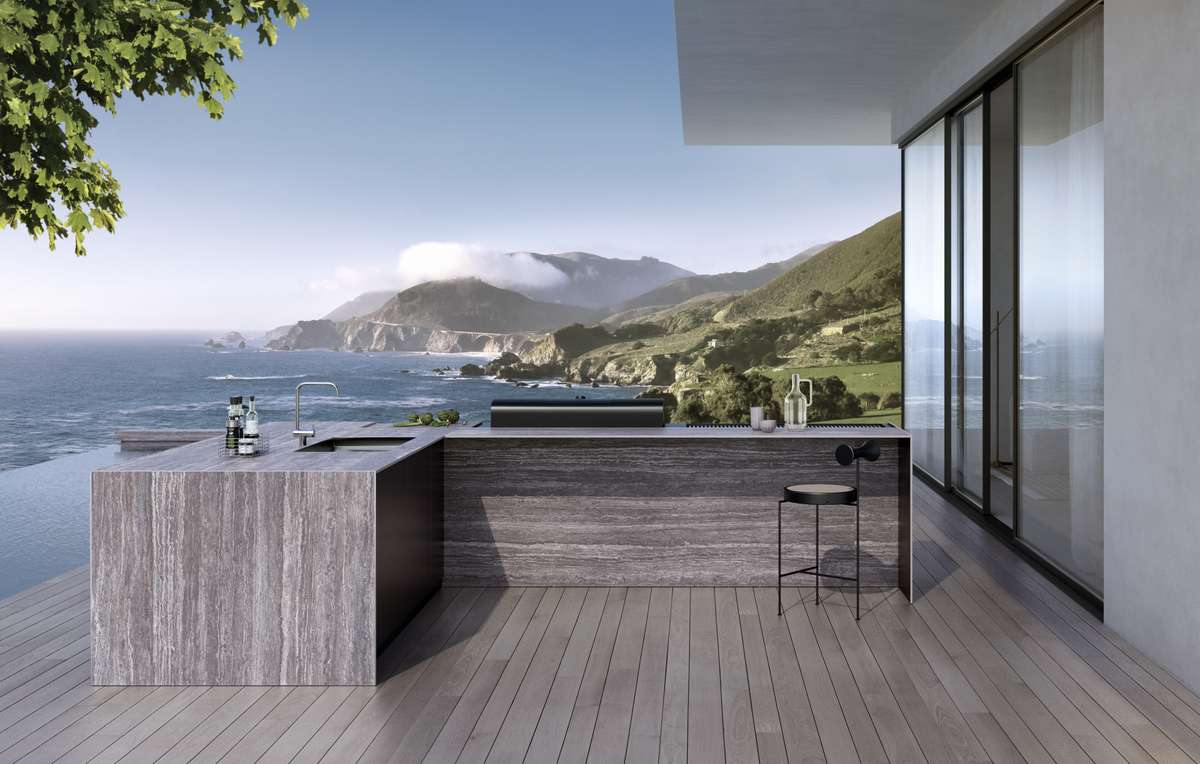
Material
Large format Italian porcelain
Thickness
20mm for outdoor runs
12mm where fully supported
Finish
Matt or structured
not polished
Applications
Worktops, cladding, flooring, tables
View slabs
London SW17
Manchester OL7
This page covers what to specify, what to tell your fabricator, and what porcelain will and will not do outdoors. If you want to see the material first, we hold full slabs at our warehouses in London and Manchester.
Why porcelain works outdoors
Frost resistant. Large format porcelain is fired dense, with water absorption well under 0.5%. There is almost no water in the body to freeze, expand and break the surface apart over a winter. This is the property that rules out most natural stone and all engineered quartz for outdoor use.
UV resistant. The colour in a porcelain slab comes from inorganic pigments fired into the surface at over 1200°C, not from a coating or a resin. It does not yellow or fade in sunlight. A quartz worktop moved outdoors will discolour within a season or two; porcelain will look the same in ten years.
Stain resistant. The surface is effectively non-porous, so red wine, olive oil, marinade and charcoal sit on top rather than soaking in. No sealing, ever.
Heat resistant. A pan straight off the burner will not mark it, and it will not scorch next to a built-in grill.
Scratch resistant. Harder than granite on the Mohs scale, which matters outdoors where grit gets dragged across the surface.
How porcelain compares outdoors
| Porcelain | Engineered quartz | Granite | Marble | |
|---|---|---|---|---|
| Frost | Resistant | Not suitable | Resistant | Vulnerable to freeze and thaw |
| Sunlight | UV resistant, colour stable | Resin yellows and fades | Generally stable | Generally stable |
| Staining | Resistant, non-porous | Resistant | Porous, needs sealing | Porous, etches with acid |
| Heat | Resistant | Resin scorches | Resistant | Resistant |
| Sealing | None required | None required | Periodic | Periodic |
| Outdoor use | Suited | Manufacturers generally advise against | Workable with upkeep | Not recommended |
The quartz row is the one that catches people out. It is an excellent indoor worktop and the wrong material outdoors, because the resin that binds it discolours under UV. Most quartz manufacturers exclude outdoor installations from their warranty for exactly that reason.
Thickness for an outdoor worktop
20mm is the usual specification for an outdoor run. It gives you the mass to span between supports, takes a mitred edge comfortably, and is more forgiving of the knocks an outdoor kitchen takes.
12mm can be used outdoors, but only where the slab is fully supported on a continuous substrate rather than bridging a gap. If you are building on a modular frame with open bays, specify 20mm and save yourself the argument.
Both thicknesses are available across the Infinity Surfaces range. Which ranges are held in 20mm changes with stock, so ask us before you specify a particular slab.
Finishes: matt over polished
For outdoor work we would almost always point you at a matt or structured finish rather than a polished one. Polished surfaces show water spotting badly outdoors, and they are the wrong choice anywhere underfoot or anywhere that gets wet.
Infinity classify their matt finish as R9 under DIN 51130. Satin and polished finishes carry no R rating. We do not hold PTV data for these slabs, and where slip resistance genuinely matters, an R rating is not a substitute for a pendulum test on the finish you are actually using. Our slip resistance page explains why, and what we recommend instead.
What to tell your fabricator
Support and substrate. Porcelain is strong in compression and less forgiving in bending. The frame underneath needs to be level, rigid and continuous under any cut-out. Most outdoor failures are frame failures, not slab failures.
Cut-outs. Sinks, grills and burner units all need radiused internal corners, never square ones. A square corner is where a crack starts.
Falls and drainage. Build in a slight fall so rain runs off rather than standing. Standing water on a horizontal surface is a dirt and limescale problem, not a durability one, but it is easier to design out than to clean off.
Movement. An outdoor run sees a far wider temperature swing than an indoor one. Leave the slab room to move at the perimeter and use a flexible adhesive rated for exterior use.
Mitred edges. A mitred edge works outdoors as well as in, and it is how you get a thick visual edge from a 12 or 20mm slab. Our page on porcelain worktops covers edge options in more detail.
Outdoor dining tables
The same material makes an excellent outdoor table top, for the same reasons: it will not fade, stain or mark, and it can be left out all year. We cover this separately on our porcelain tables page.
Cleaning and upkeep
Soapy water for everything routine. For barbecue grease or ingrained dirt, a standard porcelain cleaner and a non-scratch pad. No sealing, no annual treatment, no re-polishing. That is most of the point of specifying it.
See the slab before you specify
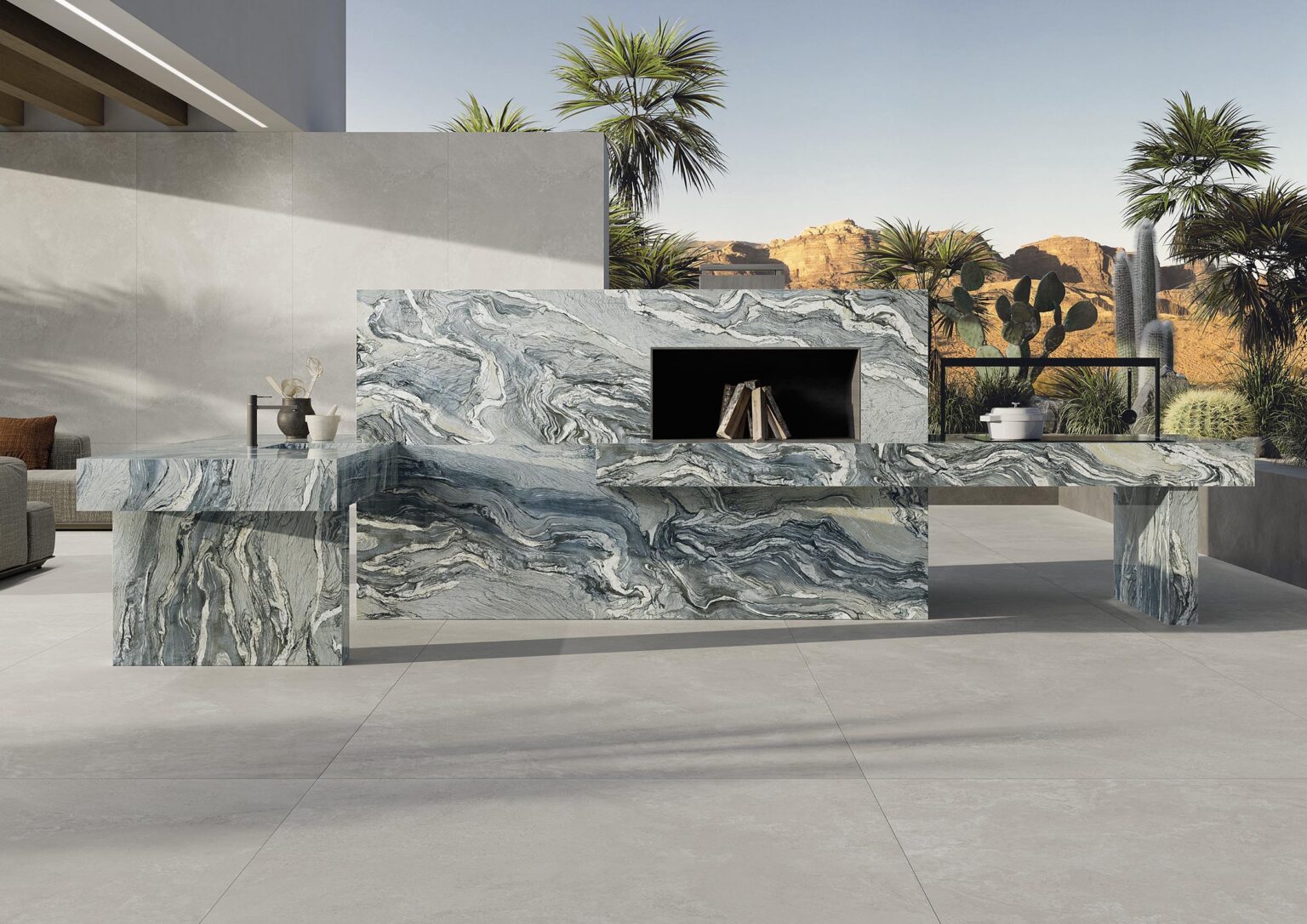
An outdoor kitchen is usually one long run in one material, so the veining across that slab matters more than it would on a small indoor island. A sample tells you the colour; it tells you nothing about where the vein falls on a 3200mm piece.
We hold full slabs at Wimbledon in London (SW17) and Ashton-under-Lyne in Manchester (OL7). Both are trade warehouses rather than showrooms, and both are by appointment, because the slabs need pulling and standing ready before you arrive. Book a warehouse visit to view full slabs, or send us the project details and we will come back to you.
Frequently asked questions
Can porcelain worktops be used outdoors?
Yes. Large format porcelain is frost resistant, UV resistant and stain resistant, which makes it one of the few worktop materials genuinely suited to a permanent outdoor installation in the UK climate.
Will porcelain fade in sunlight?
No. The colour is fired into the body using inorganic pigments rather than applied as a coating, so it is UV resistant and will not yellow or fade. This is the main reason quartz cannot be used outdoors and porcelain can.
Is porcelain frost resistant?
Yes. Water absorption is well below 0.5%, so there is effectively no moisture held in the slab to freeze and expand. It will not spall or crack through a UK winter.
What thickness should an outdoor kitchen worktop be?
20mm for most outdoor runs. 12mm is possible where the slab is fully supported on a continuous substrate, but 20mm is the safer specification for a frame with open bays or any span.
Do outdoor porcelain surfaces get slippery when wet?
Finish is what decides this. Matt and structured finishes are the right choice outdoors; polished is not. Infinity classify their matt finish as R9 under DIN 51130, and we do not hold PTV data for these slabs. Where slip resistance is critical, we recommend independent pendulum testing of the specified finish.
Where can I see outdoor porcelain slabs in the UK?
At our warehouses in London (Wimbledon, SW17) and Manchester (Ashton-under-Lyne, OL7). Both hold full slabs and both are by appointment.