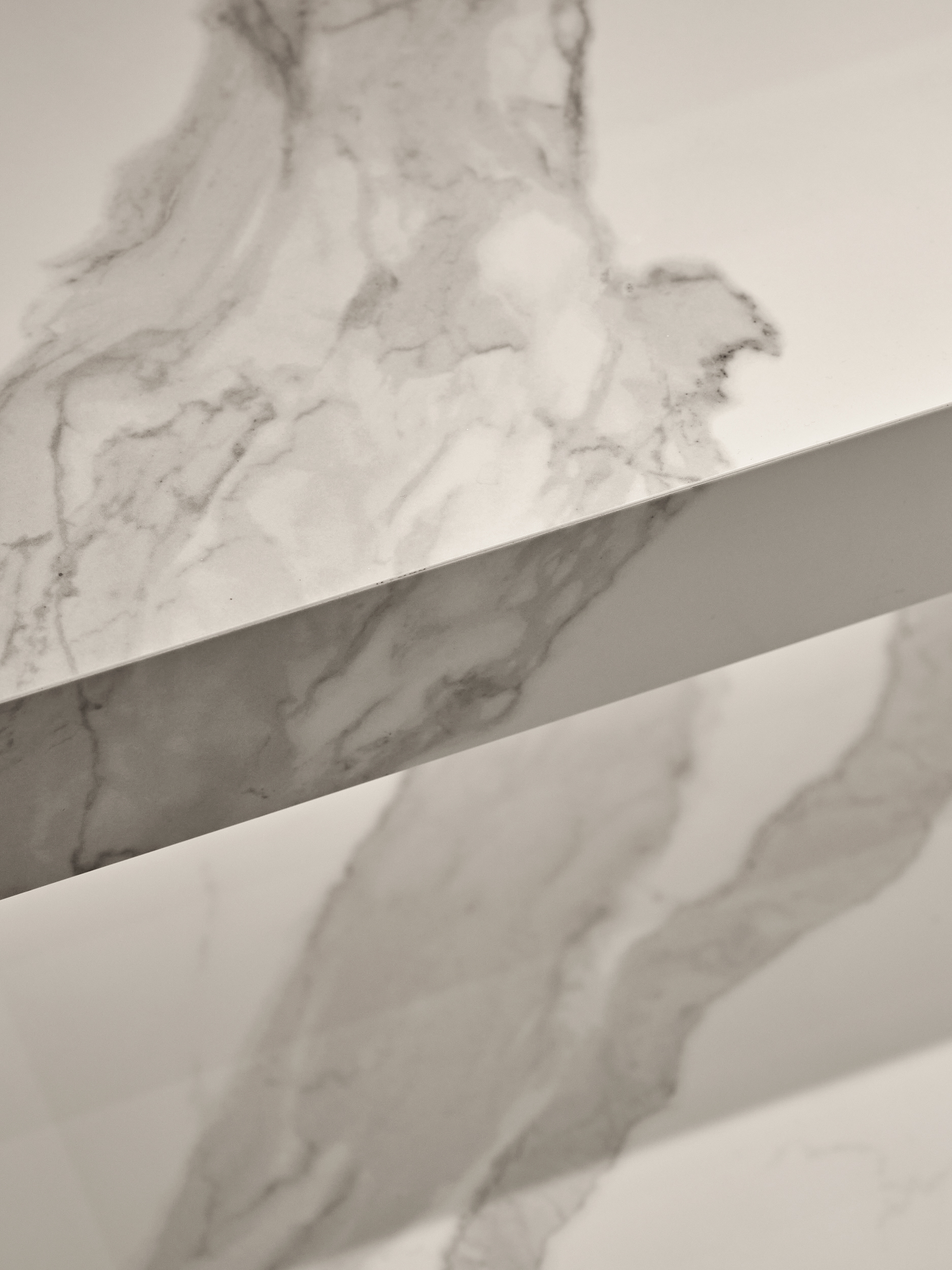
Mitred Porcelain Worktops: A Fabricator’s Guide
A mitred edge is the detail behind almost every thick, monolithic worktop you see in a design magazine. The slab is 12mm. The edge reads as 60mm or more. This page covers how that is done, what it asks of the fabricator, and which Infinity slabs take it well.
Clay International are the UK distributor for Infinity Surfaces. We supply the slabs, and fabricators cut and bond them. What follows is written for the people doing that work, and for the designers specifying it.
What a mitred edge actually is
Two pieces of porcelain are cut at 45 degrees along the edge that will meet. Bonded together, the two cuts form a 90 degree corner, and the join sits on the arris where the eye expects a corner anyway. The vertical piece, usually called the return or the apron, hangs down from the top.
The depth of that return is what sets the apparent thickness. A 12mm slab with a 50mm return reads as a 50mm worktop. The material is still 12mm thick, so the weight, the handling and the load on the carcass stay close to what a thin slab would be.
That is the whole appeal. You get the look of a thick solid slab without the weight, the cost or the structural consequences of one. In solid stone, a 60mm worktop is 60mm of stone.
Why mitring matters more in porcelain than in stone
Porcelain is supplied in large thin sheets. Infinity slabs are 3200 x 1600mm in 6mm, 3240 x 1620mm unrectified in 12mm, and 3240 x 1590mm unrectified in 20mm. The usable working area is 3200 x 1600mm in 6mm and 12mm, and about 3200 x 1570mm in 20mm. Those thicknesses are chosen for transport, handling and fixing, not for how an edge should look.
So in porcelain the mitre is not an optional decorative profile the way a bullnose is in granite. It is the main way of making a thin material read as a substantial one. Without it, a porcelain worktop announces its thickness at every edge. If you are still weighing up the material itself, our guide to porcelain worktops in the UK covers thicknesses, finishes and what to expect on cost.
There is a second reason, and it is the one that separates good work from adequate work. Porcelain is decorated on the face. The body underneath is not the same as the surface, so a cut edge shows the biscuit rather than the pattern. A square edge on a veined slab puts a pale line along the whole front. A mitre folds the decorated face over the corner, so the veining carries down the return and the edge looks like stone rather than like a cut sheet.
Mitred, bullnose or square
Mitred
The right choice where the edge is on show and the slab is veined. Most expensive in labour, most demanding to fabricate, and the only option that hides the body of the material completely.
Square
The slab thickness left as it is. Honest, clean and cheap, and it suits a plain or concrete effect slab where there is no veining to interrupt. On a heavily veined marble effect it will show the edge for what it is.
Bullnose and chamfer
Both remove material from the face at the corner, so on a decorated porcelain both will cut into the printed layer to some degree. They are more at home on solid surface and stone than on porcelain, and in porcelain they are usually specified on 20mm, where there is more material to work with.
What fabricators need to know before cutting
None of this is exotic, but a mitre is unforgiving and the failures are all at the same few points.
- The arris is fragile. A true 45 degree cut tapers the material to nothing at the tip. That feather edge chips easily in handling and in use. Many fabricators take a small flat off the tip, a fraction of a millimetre, to give the corner something to be. Agree with the client whether the detail is a crisp arris or a very fine flat, because it changes how the edge catches light.
- The cut has to be straight along its whole length. Any wander shows as a varying glue line, which is the clearest tell of a poorly made mitre. Rectified slabs give a known straight reference to work from.
- Bond line colour matters more than bond strength. Structurally the joint is not heavily loaded. Visually it is at eye level on an island. Colour matched adhesive, and taking the time to match it to the slab rather than to the range, is what makes the join disappear.
- Support the return. A deep apron on a long run wants backing or battens behind it, both to hold line during bonding and to stop the panel reading as hollow when knocked.
- Think about the cut out positions first. On an island with a mitre on all four sides, the sink and hob cut outs decide how much continuous material is left. Plan them against the mitre, not after it.
Thickness choice follows the same logic. 12mm is the usual worktop format and mitres cleanly. 20mm gives a more robust arris and suits exposed edges and outdoor work, at the cost of weight. 6mm is a cladding thickness, and while it can be mitred for furniture and panel returns, it is not a worktop material.
Which Infinity slabs mitre well
Any of them can be mitred. The question is whether the result rewards the work.
Directional veining is where a mitre earns its keep. On a slab where the vein runs across the face, the vein can be carried over the corner so it continues down the return without a break. Done properly it is the detail people notice without knowing why. Calacatta Viola MB22, Calacatta Oro MB06 and Cipollino Blue MB25 all have enough movement to make it worth planning the cut around the vein.
Plain and evenly textured slabs are the easy ones. Absolute White SC01, the concrete effects and the fine grained stone effects have nothing to align, so the only thing to get right is the joint itself. These are the slabs to start on.
Dark and polished slabs are the least forgiving. A polished black shows every imperfection in a glue line. Nero Marquinia MB11 and Metal Dark Black ME02 are worth a test piece before committing a full island.
Bookmatching and mitring together is the most demanding combination and the most striking. Both decisions are made at the slab, which is why it is worth seeing the material rather than working from a sample.
Where mitred worktops are being specified
- Kitchen islands and peninsulas, usually with a waterfall return to the floor
- Bathroom vanities and integrated basin surrounds
- Dining and boardroom tables, where the edge is at seated eye level
- Reception desks, bar fronts and retail counters
- Fireplace surrounds and hearths
In open plan rooms the island is furniture as much as worktop, which is why the edge detail carries so much of the effect. More on the material itself in our guides to Infinity worktops and bespoke porcelain tables.
Common questions
What is a mitred edge?
A mitred edge is made by cutting two pieces of slab at 45 degrees and bonding them at the corner, so the worktop looks like a solid block of material rather than a thin sheet. It is how a 12mm porcelain slab ends up reading as a 60mm or 100mm worktop.
How thick can a mitred porcelain edge be?
Returns of 60mm and more are routine, and the limit is practical rather than technical: a deeper apron uses more material and needs more support. 40mm to 60mm covers most kitchen work.
Is a mitred edge weaker than a solid edge?
Well made, it performs normally in domestic and commercial use. The vulnerable point is the arris at the corner rather than the bonded joint, which is why the tip detail and careful handling during installation matter.
Can the veining really line up around the corner?
Yes, on a slab with directional veining, provided it is planned before cutting. It is a fabrication decision made at the slab, not something that can be corrected afterwards.
Does Clay International fabricate worktops?
No. We are the UK distributor for Infinity Surfaces and supply the slabs. Fabrication is done by specialists, and our stockist and fabricator finder lists them by location.
Seeing the slabs
Full slabs are held at our London and Manchester warehouses and can be viewed by appointment, which is the only sensible way to judge veining before planning a mitre. We supply the trade across the UK, so your fabricator can order on your behalf. Find your nearest through the stockist and fabricator finder, or get in touch if you want to talk a detail through.